
Australia, Energy Security And A Mad Max Future
The brave new world


For the longest time the issue of energy security and ensuring adequate supplies of vital fuels in a crisis has not been a major consideration for successive Australian federal governments.
Members of Parliament such as Independent Bob Katter and former Senator Rex Patrick have raised the issue on multiple occasions, but concerns have largely fallen on deaf ears.
According to recent stats shared by Energy Minister Chris Bowen, Australia has stockpiles equal to 36 days of petrol, 32 days of diesel and 29 days of jet fuel.
This is well below the obligation Australia holds under its agreement with the International Energy Agency to hold reserves of fuel equal to at least 90 days’ worth of imports.
In the new world of a Strait of Hormuz that is largely closed to traffic, all of a sudden energy security and adequate fuel reserves has been catapulted to the forefront.
So today we are going to be examining Australia’s energy security in detail covering:
Australia’s strategic oil reserve
Domestic refining capacity over time
Sources of Australian fuel imports by nation
Sources of Australian fertilizer imports
Proven reserves of oil and gas. Current production and consumption levels for both.
The possibility of an “Every man for himself” type scenario, a ‘Mad Max’ world if you will and how Australia may cope.
Australia’s Strategic Oil Reserve
During the height of the pandemic in March 2020, the Morrison government signed an agreement with the United States to create an Australian strategic oil reserve, with the oil to be held within the holding tanks of the American Strategic Petroleum Reserve (SPR).
In April 2020, it was confirmed that the Morrison government had purchased $94 million worth of oil.
In March 2022, the total size of the stockpile was confirmed by the Morrison government at 1.7 million barrels, in a press release detailing how Australian oil in the U.S SPR would be part of the coordinated release of oil reserves with 30 other nations to add to global supply amidst the impact of the war in Ukraine.
As part of this sustained effort the entire stock was sold and Australia’s short lived strategic oil reserve effectively ceased to exist.
But it was never really much of a reserve to begin with.
At today’s rate of consumption this accounts for roughly 36 hours’ worth of supply.
This is a stark contrast to other parts of the developed world that are heavily reliant on imports of fuel or oil.
For example, the South Korean government possesses reserves of around 100 million barrels of oil.
According to OPIS: “Combined with private sector holdings, South Korea’s total strategic reserves equate to roughly 200–208 days of demand.”
It’s a similar story with Japan, which possesses reserves domestically equivalent to 247 days worth of consumption, 146 days in government owned facilities and 101 held by the private sector.
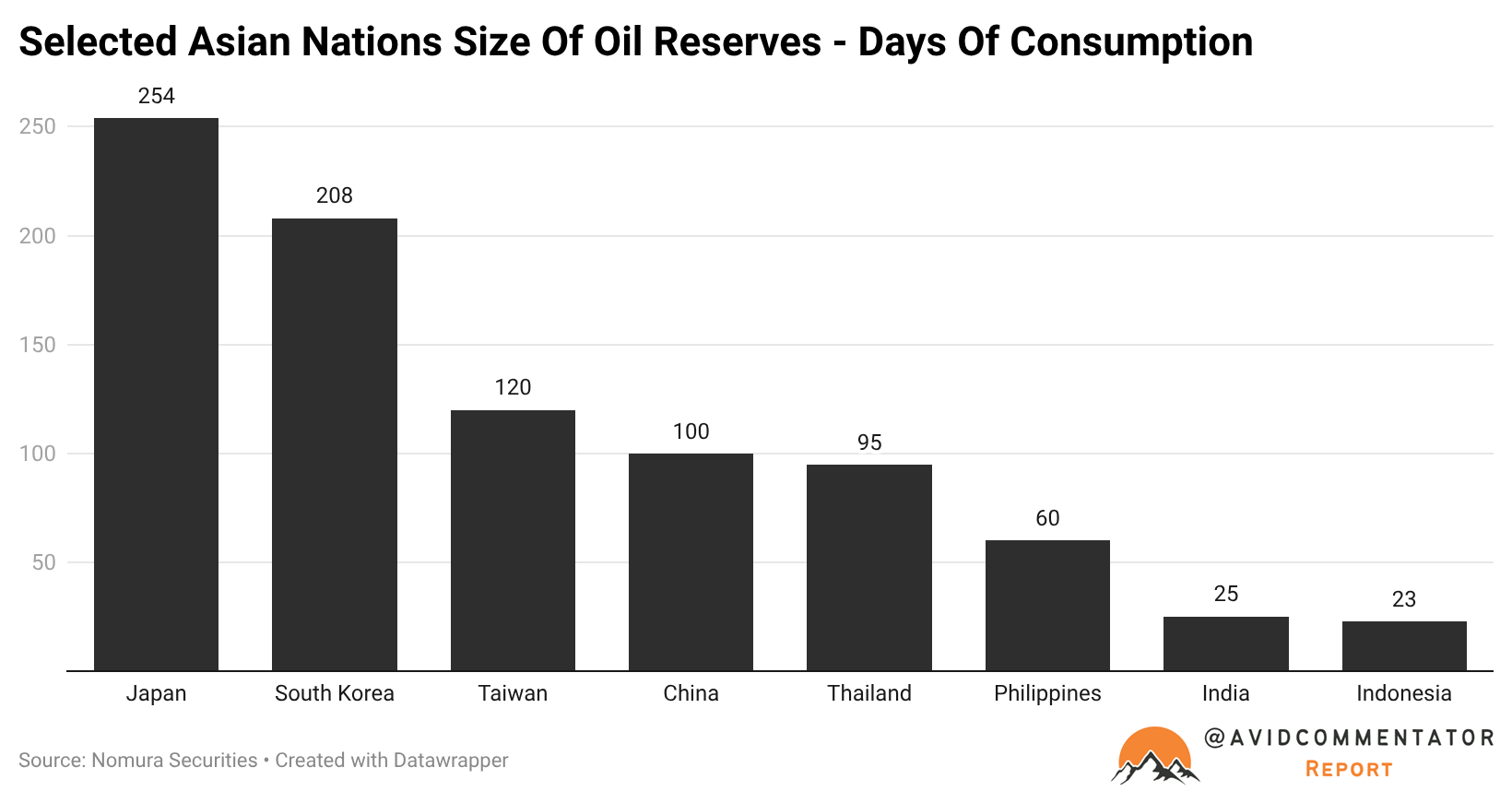
Despite Australia’s extreme reliance on seaborne imports of fuel like nations such as Japan or South Korea, Australia lacks both the oil reserves to ensure domestic supply over a more protracted period and the refinery capacity required to deliver it.
Domestic Refining Capacity
Over the last 15 years the capacity of the Australian energy sector to refine oil has declined dramatically.
In 2009, the nation held capacity for refining 734,000 barrels of fuel and other refined hydrocarbons per day.
According to figures from the Australian Institute of Petroleum, this equated to approximately 83.4% of total refined petroleum product consumption at the time (880,000 barrels per day).
Over the next 17 years, Australia’s refinery capacity would continue to dwindle.
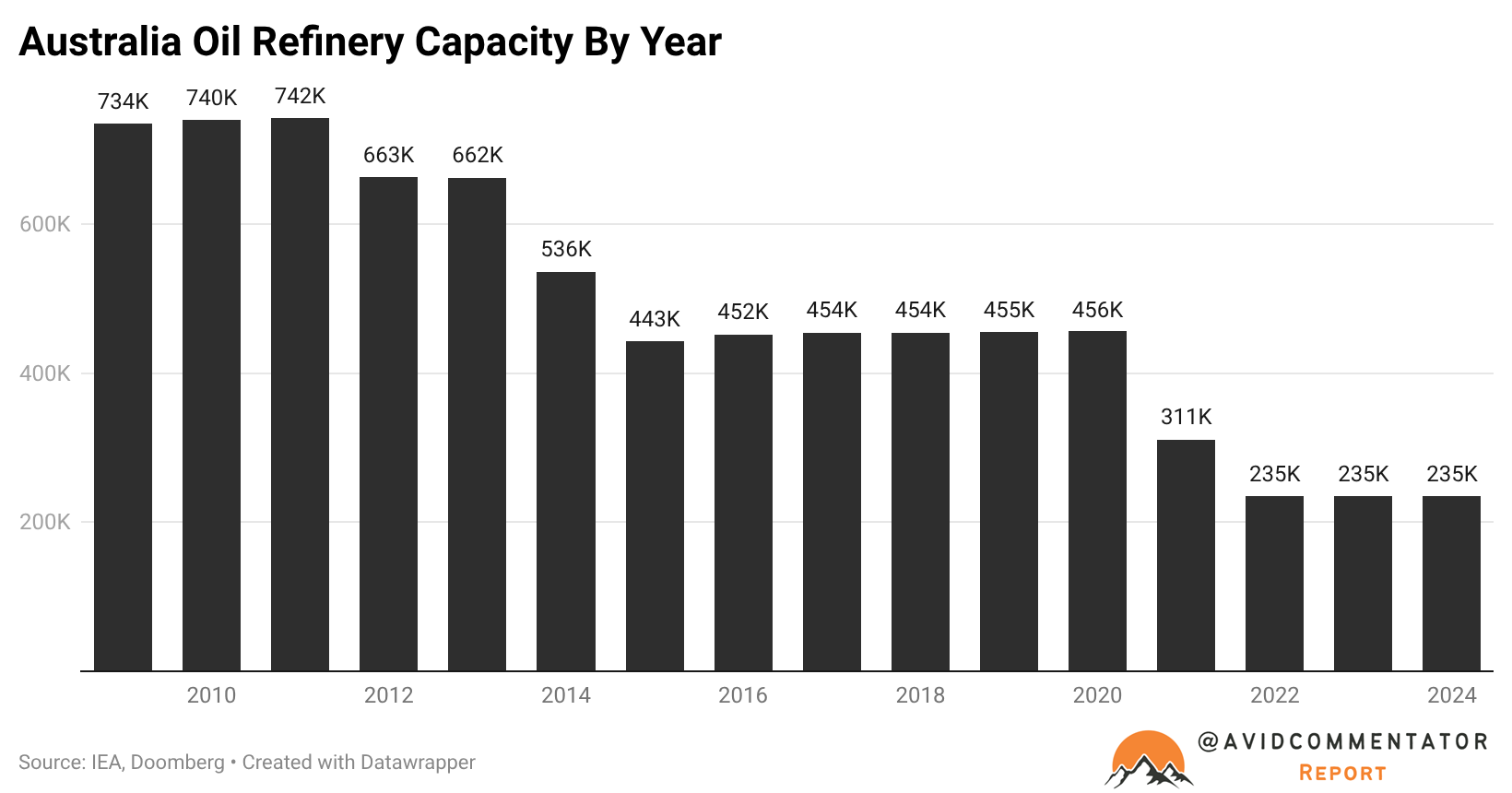
As of 2025, capacity has fallen to just 235,000 barrels per day and that is with the two remaining refineries running above 100% of their sticker rates of production.
Meanwhile, data from the U.S EIA has seen production rise significantly since 2009, with total refined petroleum product consumption up 1.15 million barrels per day.
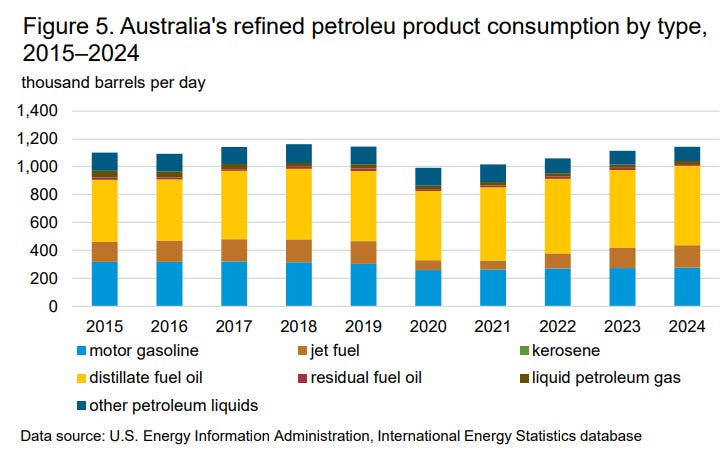
“Distillate fuel oil” mostly refers to diesel fuel and other derivatives.
Sources For Australia’s Fuel
Overall Australia imports approximately 90% of its liquid fuels such as petrol, diesel and aviation fuel, with consumption coming to roughly 1.035 million barrels each day.
Keep reading with a 7-day free trial
Subscribe to Burnout Economics to keep reading this post and get 7 days of free access to the full post archives.