
The Great Fuel & Oil Inventory Burn To Save The World
How long can we keep this up?


As the war in the Persian Gulf continues to throttle traffic through the Strait of Hormuz down to a relative trickle versus pre-war levels, it’s striking how oil prices have not risen more strongly despite somewhere around 13 million barrels per day in supply being taken off the table.
Leaving aside the never ending stream of headlines and Trump tweets hammering oil traders going long, in the physical world there have been two major factors effectively acting as Atlas and holding together the balance of oil and fuel supplies, at least for now, China and the United States.
According to an analysis from JP Morgan, net U.S seaborne oil and fuel exports have risen by 3.8 million barrels per day in year on year terms in the last 30 days.
On the other side of the coin, China’s net imports of oil, fuel and other products have fallen by 5.5 million barrels per day in year on year terms in the last 30 days.
In short, through these measures Washington and Beijing are currently offsetting approximately 70% of the blow to global oil and fuel supplies.
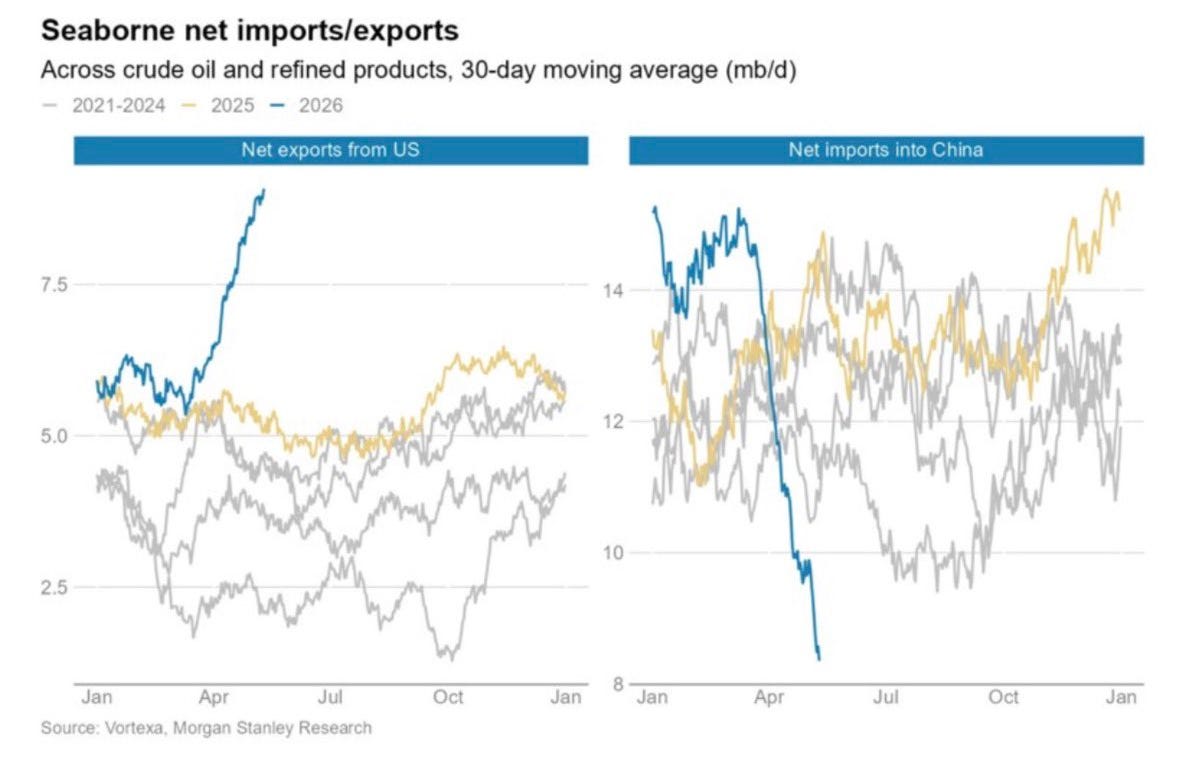
Source: JP Morgan
But how long can this realistically continue?
China has by far the largest oil reserves in the world, holding what some estimate to be over 1.3 billion barrels of oil in their strategic reserves alone.
So theoretically China could keep this up for months without being too worse for wear, provided they were willing to drain their reserves so dramatically.
Which raises an interesting question that we can unfortunately only speculate upon, why would they?
Why burn through precious reserves when the real beneficiaries are not in the Middle Kingdom, instead this heavily benefits China’s rivals in East Asia, such as South Korea and Japan, as well as the United States, which finds itself with greater time to continue its war against Iran.
The United States on the other hand lacks that same scope to continue burning through its stock of commercial fuel reserves.
In order to quantify this issue, we will be looking at the history of commercial U.S gasoline and distillate fuel oil (diesel, heating etc) inventories, exploring their historic lows, their current levels and how much scope there is to continue to burn through stocks.
The Politically Vital - Gasoline
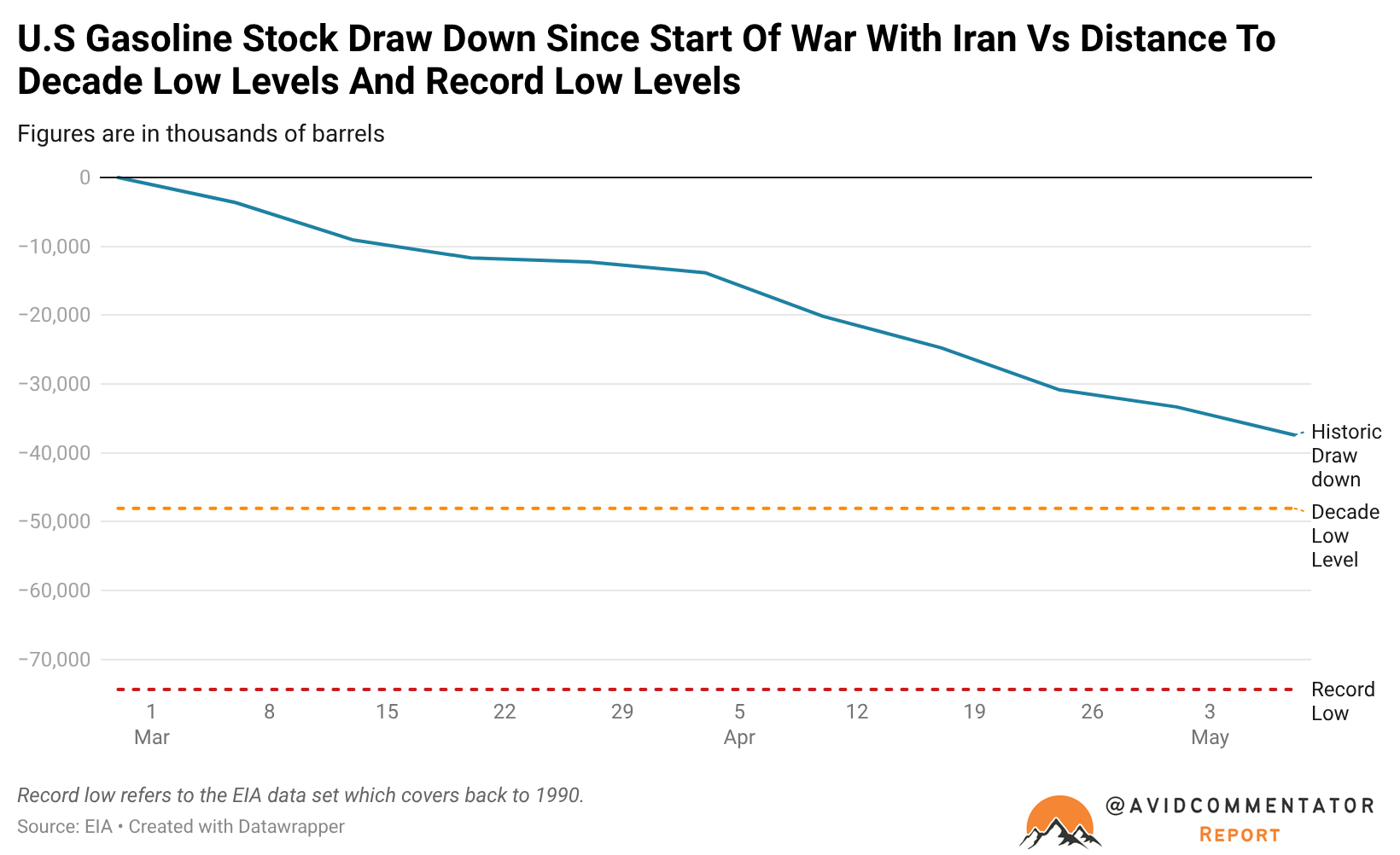
In the last reading prior to the war in the Middle East, the U.S had 253.1 million barrels of gasoline in its commercial stocks.
Since then, it has expended 37.4 million barrels of gasoline in net terms from it’s commercial stocks.
As the chart below illustrates, most of that draw down has come since the start of April, which is where outflows from inventories began to accelerate more significantly.
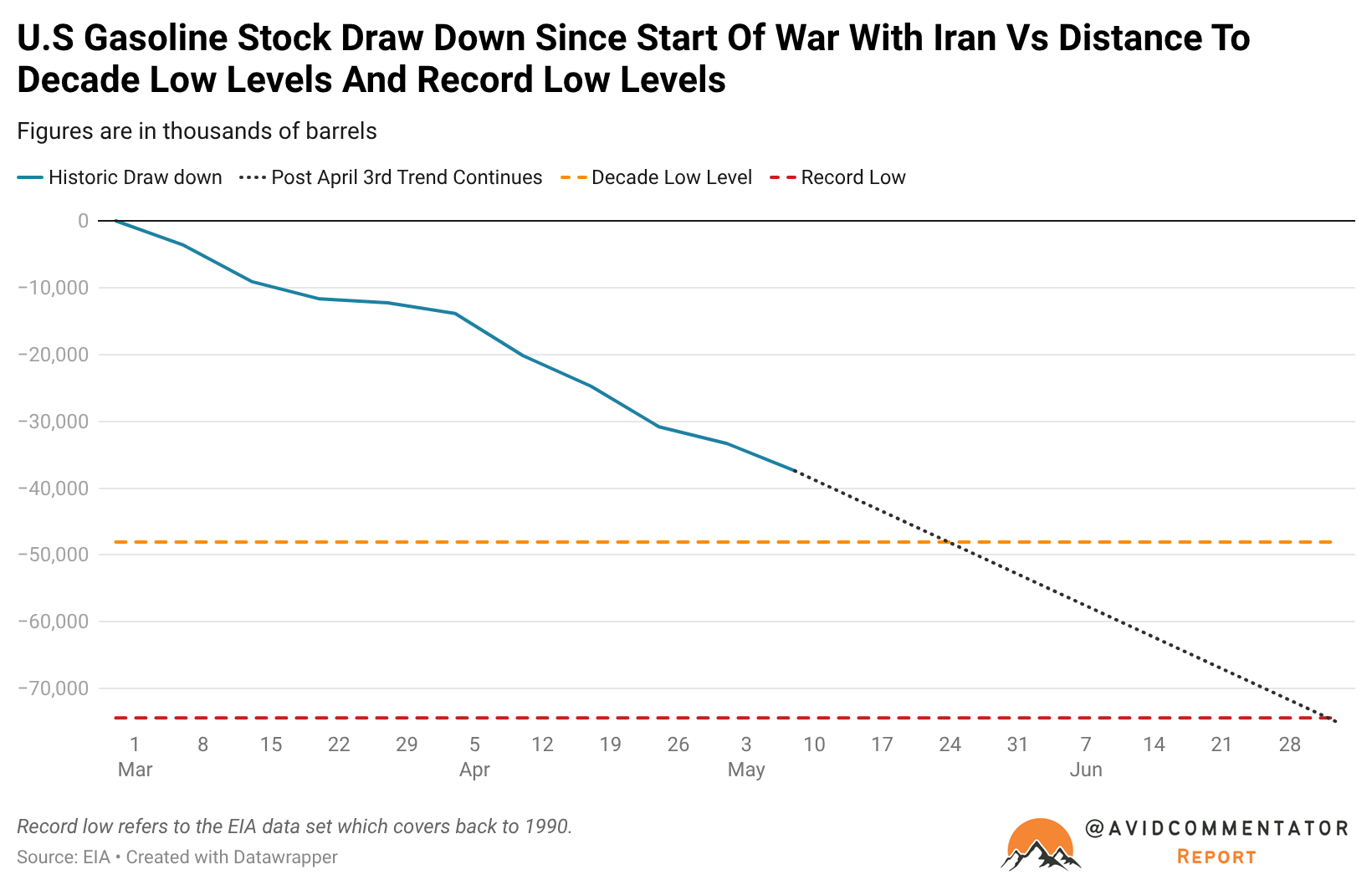
In order to put this into a bit of perspective, the chart has the level of draw down from pre-war levels required to hit decade low levels and all time low levels since the current EIA data set began in 1990.
If we were to somewhat crudely assume that the rate of gasoline inventory draw down seen since the 3rd of April was to continue, by the 29th of May inventories would hit decade low levels.
If the trend was to continue beyond that, by the 2nd of July inventories would hit an all time low.
Energy sector expert Anas Alhajji outlined how vulnerable this strategy was leaving the U.S in a recent appearance on Mario Nawfal’s show on social media platform X (formerly known as Twitter).
“If we have a major problem with the refinery outage, we are in deep trouble, not in terms of oil and crude oil. This is going to be literally jet fuel, gasoline and diesel.” Alhajji said
Moving The Big Stuff - Diesel
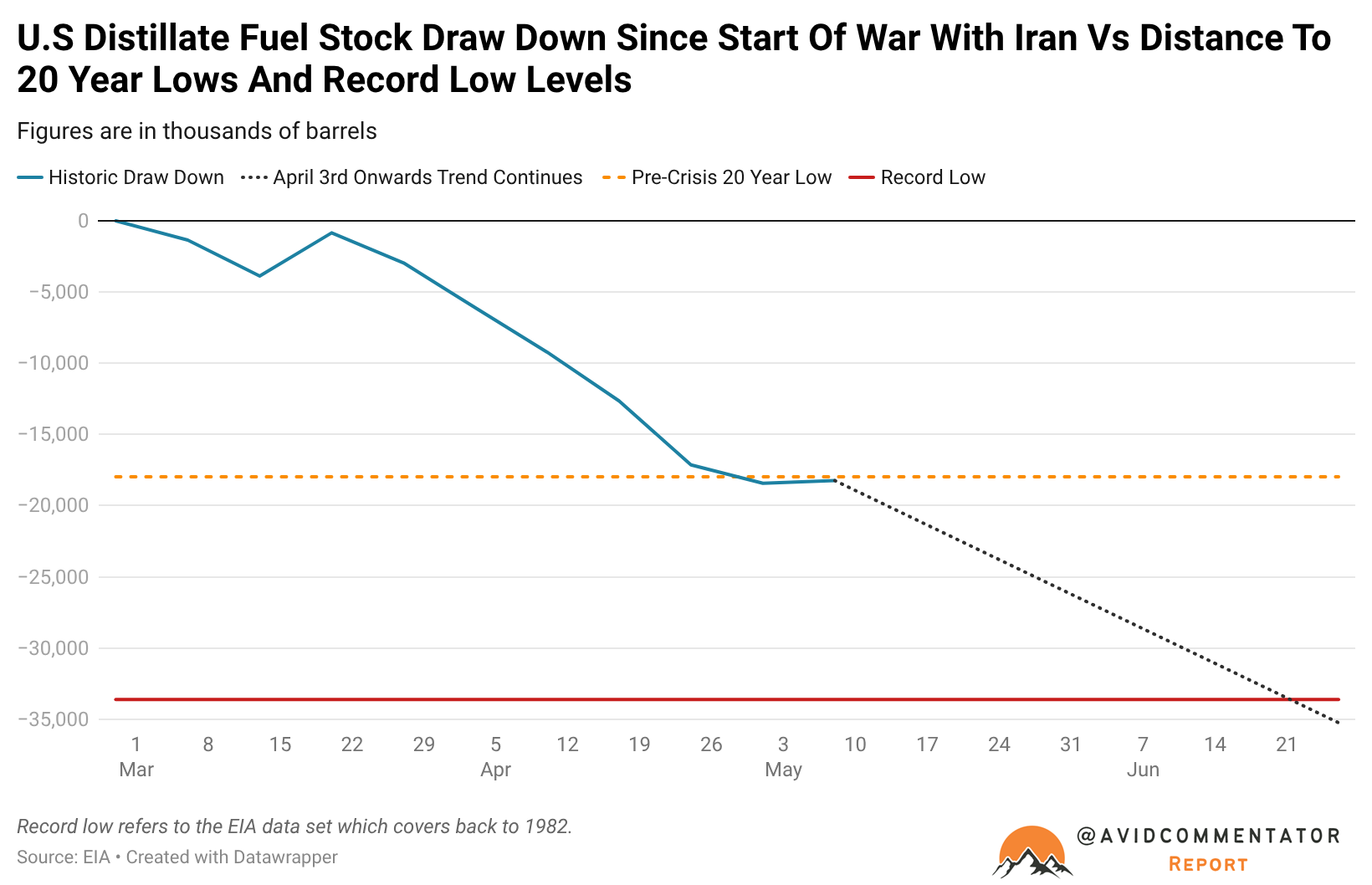
In terms of distillate fuel oil which encompasses diesel and heating oil, the picture is far more concerning.
In the last reading prior to the war in the Middle East, the U.S had 120.8 million barrels of distillate fuel oil in its commercial stocks.
Since then, it has expended 18.2 million barrels of distillate fuel oil in net terms from it’s commercial stocks.
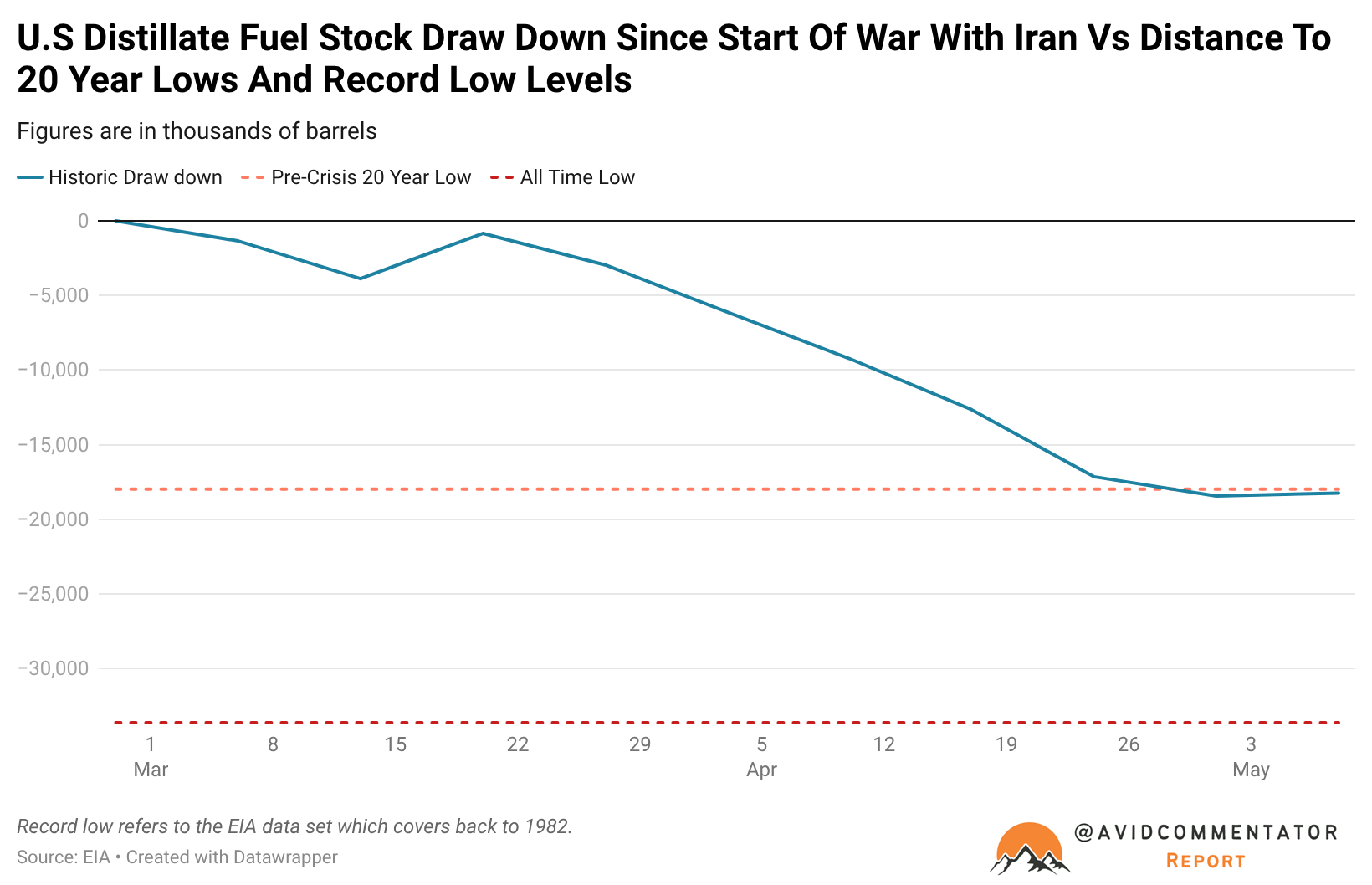
With the exception of the prior week’s data, the current stock of distillate fuel oil is at it’s lowest level since May 2003.
The dramatic and much larger than expected slowdown in the inventory burn of distillate fuel oil suggests we may be nearing the limits of the reduction in stocks.
However, if we were to assume that for whatever reason the inventory draw down continued at the same rate as it has since April 3rd, by the 22nd of June stocks would hit the lowest level since EIA records began in 1982.
The Takeaway
As oil industry expert Anas Alhajji correctly pointed out, the slack in the U.S petroleum supply system is swiftly evaporating.
U.S refiners and fuel suppliers are not run by unintelligent people, they know that the scope for outsized exports will swiftly draw to a close in the weeks and months to come.
In the words of HFI Research, which has provided some important data and analysis throughout the crisis so far:
“We are about 3 weeks away from US petroleum product exports falling. Once the buffer is gone in the US, the elevated petroleum product exports that the world is enjoying will disappear.”
In the coming weeks exports excluding the impact of the Strategic Petroleum Reserve releases will begin to normalize.
On a longer term time horizon, by early August, the balance of the SPR will hit an all time record if the current draw down rate continues.
On the other side of the coin, China potentially continuing to draw on its reserves remains a wildcard.
Without understanding their motives and reasoning, it’s challenging to know whether or not they will continue to play the role of Atlas holding up the world.
The 13 million barrel per day hole left by the throttling of traffic through the Strait of Hormuz (after the impact of pipelines and workarounds) was never going to be able to be fully offset on a long term time horizon.
The U.S and China have seemingly tried, inadvertently or otherwise, but those efforts are simply not sustainable.
Ultimately, the longer crisis in the Middle East persists, the greater the likelihood becomes of a far greater oil shock and prices hitting new all time highs.
— If you would like to help support my work by making a one off donation that would be much appreciated, you can do so via Paypal here or via Buy me a coffee.

If you would like to support my work on an ongoing basis, you can do so by subscribing to my Substack or via Paypal here
Thank you for your readership.
The HFI three-week call is the sharpest timeline in this piece. Worth watching closely.
One upstream layer that feeds your gasoline and distillate data: US refiners are running at 5-year seasonal high throughput while cutting back on crude procurement. They’re converting existing crude inventory into exportable products — not buying new barrels at crisis premiums. The IEA confirmed the draw: 250 million barrels of global inventory gone in March and April alone.
When refinery crude storage depletes, throughput drops. When throughput drops, both domestic supply and the export surge stop at the same time. Your product stock charts are the downstream signal. The crude storage drawdown is the leading indicator.
The China question you raised — why drain reserves to benefit rivals — is exactly the right one to be asking.
Thanks for putting this relevant and timely well researched piece together Tarric 🙏
From my reading on historical Chinese political culture they will keep supplying the market with reserves until the USA cannot then they will reevaluate (personal opinion cease to release that is not an opinion from the readings though).
From the readings China will abide by the established power (in this case USA world power) wishes until it is clear by actions other then their own that USA are no longer the world power then they will make their move/s.
Essentially China only act when their opponent cannot or will not act of its own accord for example China became more active in Oceania only when Australia chose to stop focusing on relations in the region and backed off once Australia became active again.
China remain active in the Pacific where they have existing arrangements when Australia chose not to act and are active where USA have chosen not to act.
Time is on China’s side in terms of fuel reserves and also politically there is no fixed leadership terms in China. Trump has a limited number of days left in office which distorts any negotiations.