
The Most Important Chart In Australia
Fuel imports incoming vs normal flows

As the lack of granular transparency surrounding Australia’s future fuel supplies continues, the public have been left relying on the commentary of the Albanese government, most notably that of Energy Minister Chris Bowen and Prime Minister Anthony Albanese.
In a press conference on Saturday, Bowen stated that:
“Australia’s fuel supply remains strong, still more than 50 ships on their way to Australia”
“3.7 billion litres booked in for April”
Billions of litres fuel sounds like a great deal of supply and the fact that multiple members of the government have delivered this statistic with enthusiasm suggests that it’s a very positive outcome.
But once you get into the hard historical petroleum imports data from the Department of Climate Change, Energy, the Environment and Water, the picture swiftly begins to change.
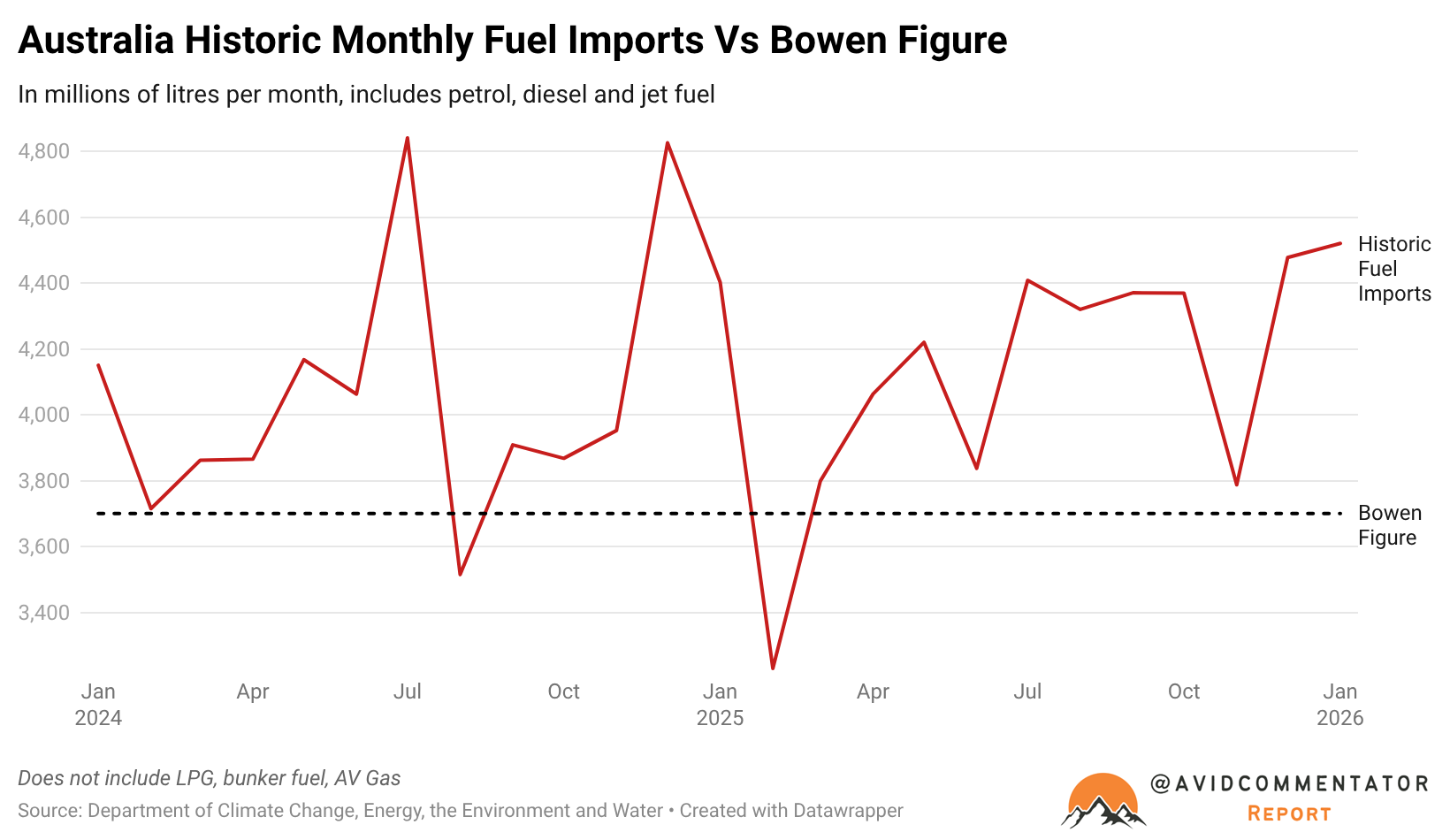
As the chart below of combined petrol, diesel and jet fuel imports on a monthly basis illustrates, 3.7 billion litres or 3,700 million litres is on the low end for monthly volumes in recent years.
With the exception of August 2024 and February 2025, each and every month has produced a higher figure for imports than the 3.7 billion litres the Albanese government has pencilled in for April.
As one might expect there are also significant seasonal variations.
For example, last April saw fuel imports in these categories of 4.06 billion litres of fuel, with May coming in at 4.22 billion.
This naturally makes no allowance for growth in fuel demand, which expanded by 198 million litres per month comparing April 2025 with April 2024.
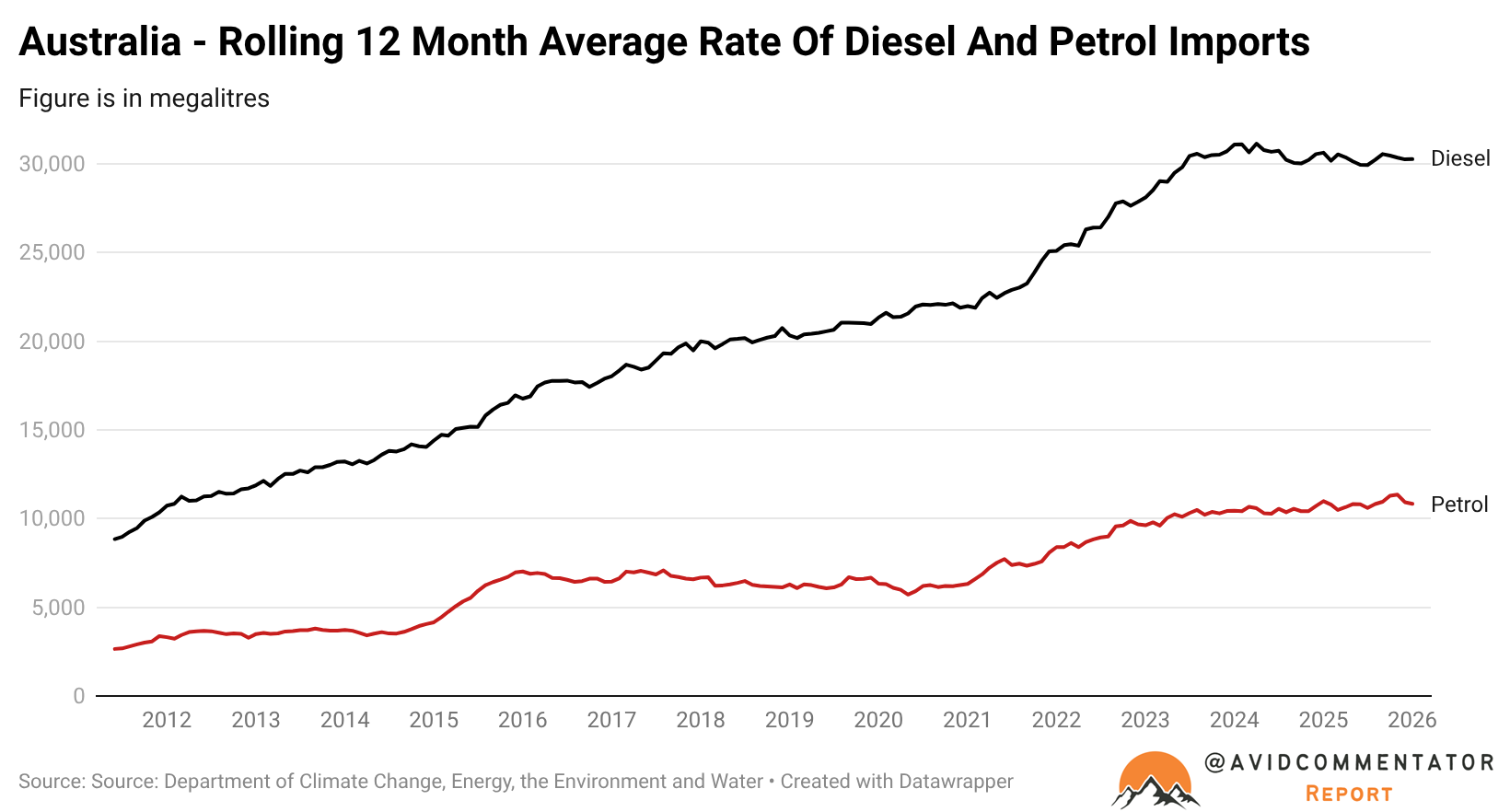
While passenger cars and commercial vehicles have all generally become significantly more fuel efficient since the Department of Climate Change, Energy, the Environment and Water data kicks off in 2010, the reality is that the closing down of refineries and the dramatic expansion of the population has seen demand for imported fuels rise dramatically.
For example, on a rolling 12 month average monthly basis, in mid-2011 Australia imported 221.1 million litres of automotive petrol per month.
On the same metric as of the latest data, that figure has risen to 902.6 million litres per month.
Its a similar story with jet fuel, up from 173.8 million per month to 692.7 million per month.
But the biggest nominal increase in demand came in the form of the nation’s diesel imports up from an average of 737.0 million litres to 2.52 billion per month.
The Takeaway
While all Australians very much hope that the fuel supply situation will not become an issue, the 3.7 billion litres in April figure provided by the Albanese government is not especially confidence inspiring for those who have done the homework on what normal import volumes look like for this time of year.
Which begs the question, if fuel imports are going to come up below the expected par, is this emblematic of a shortfall arriving in late April, as JP Morgan forecasted Australia would become vulnerable to from around this point in time in a recent note?
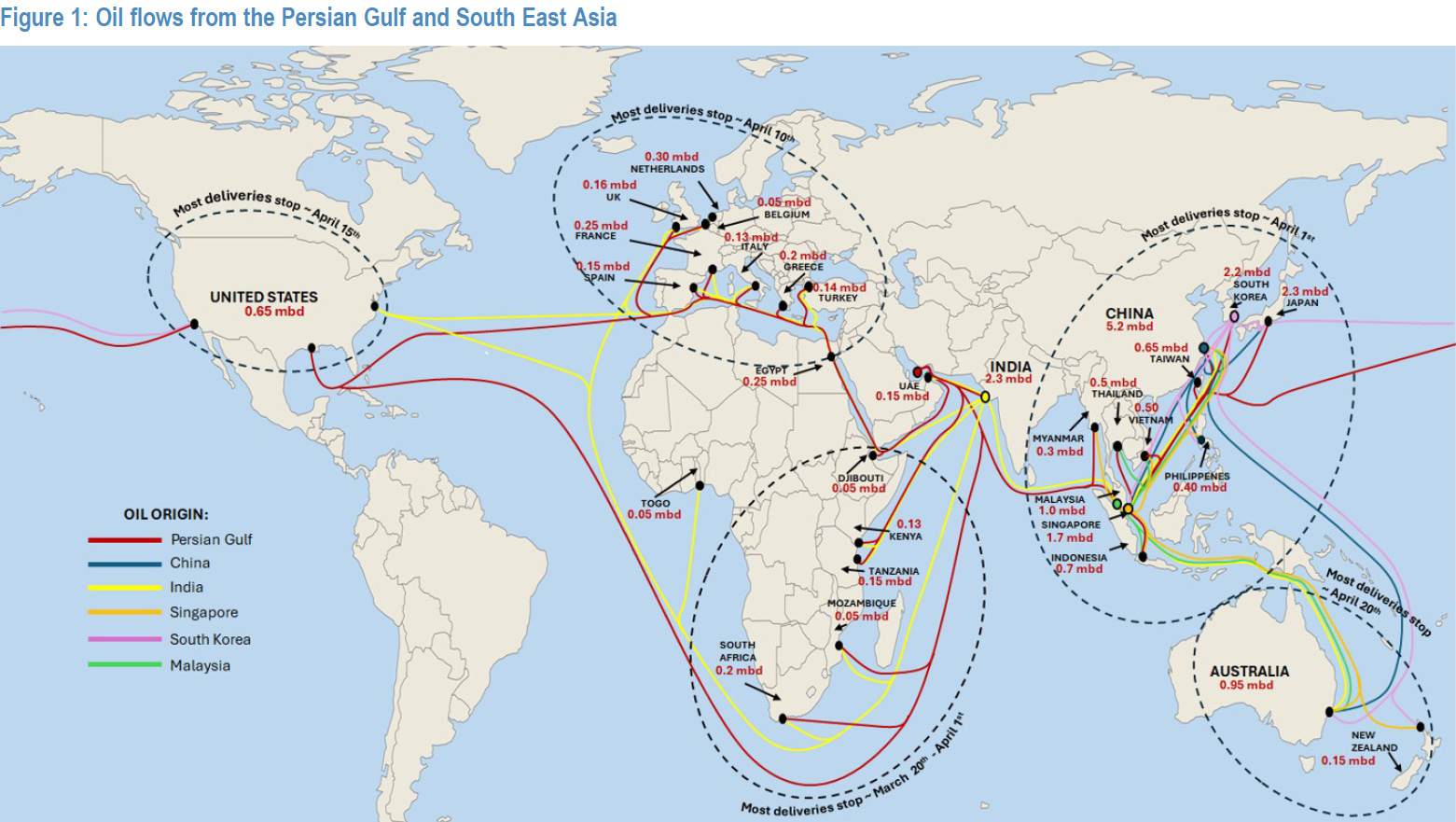
Source: JP Morgan
Or is it merely a weak month amidst something akin to business as usual as the Albanese government uses the nation’s fiscal firepower to buy up fuel and oil cargos on the spot market.
At least within the realm of diesel things are seemingly looking quite promising for April according to an analysis from Episode 3.


The problem at this stage is Australians lack the necessary granular data and transparency from the Albanese government to be able to feel reassured or if necessary to prepare for a more significant disruption to their lives.
Queensland Premier David Crisafulli has proposed that there should be a government dashboard website, which shows the public all the relevant data such as stock levels,
But instead, many Australians, even some experts, are left making suppositions based on the limited data we do have at hand, such as the historic import volumes we assessed here today.
Ultimately, there is a lamentable lack of transparency and information from the Albanese government, who in opposition urged just that.
This is unfortunately a major departure from what we are seeing from other government’s in hard hit developed world nation’s.
— If you would like to help support my work by making a one off donation that would be much appreciated, you can do so via Paypal here or via Buy me a coffee.

If you would like to support my work on an ongoing basis, you can do so by subscribing to my Substack or via Paypal here
Thank you for your readership.
It's nice to see some data-driven objective reporting. Great job.