
Why Iran Matters?
By the numbers

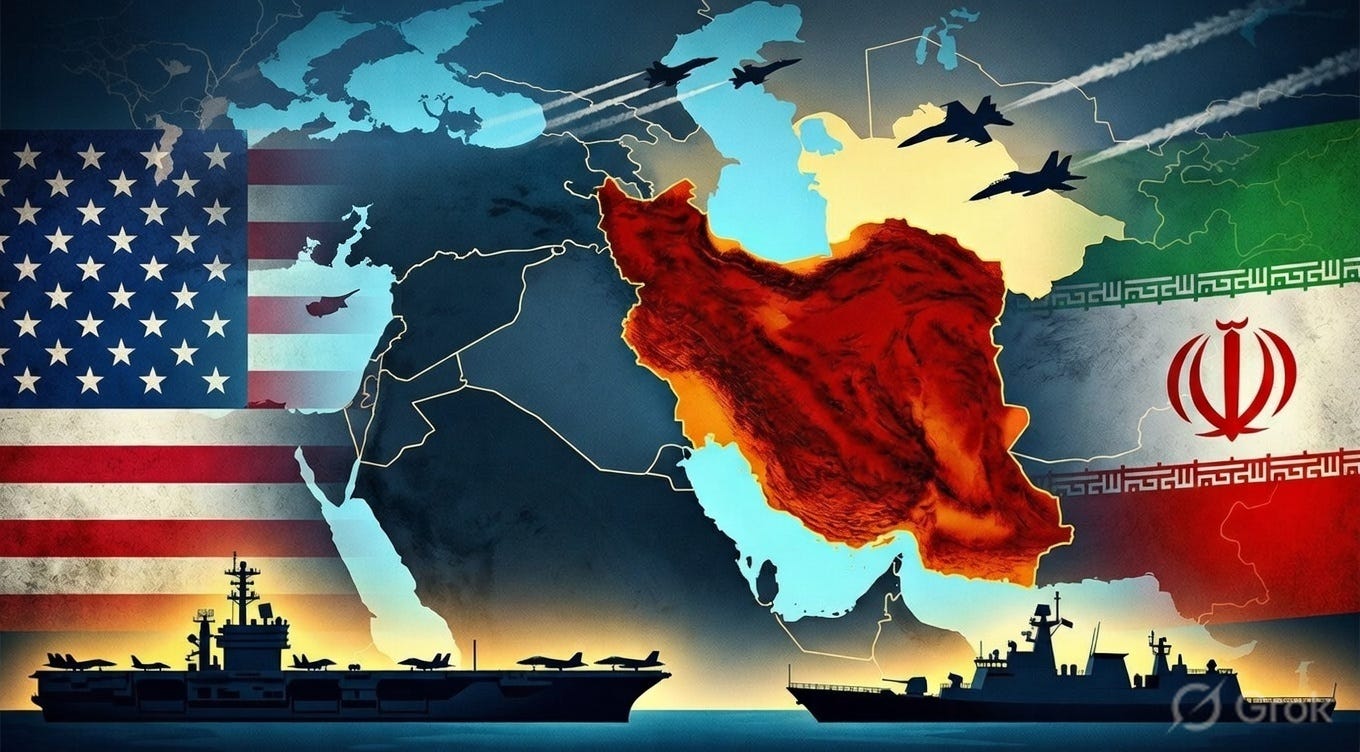
Following U.S and Israeli strikes on Iran over the weekend, the eyes of the world have once again turned to the Middle East, as a multitude of questions about the future of region and the balance of global geopolitics are raised.
While exactly how events will unfold remains unclear, what we can do is examine the existing data on why Iran is extremely relevant and explore some of the potential implications of the Iranian regime’s fall.
By The Numbers
According to a recent analysis from S&P Global, Iran exports 1.424 million barrels of oil and condensates per day.
Of this approximately 1.3 million barrels per day is crude oil, which equates to 3.0% of total global crude oil exports globally.
Where things start to get complicated from an energy perspective is Iran’s potential to influence the flow of oil and other energy through the Strait of Hormuz, one of the world’s most vital maritime trade chokepoints.
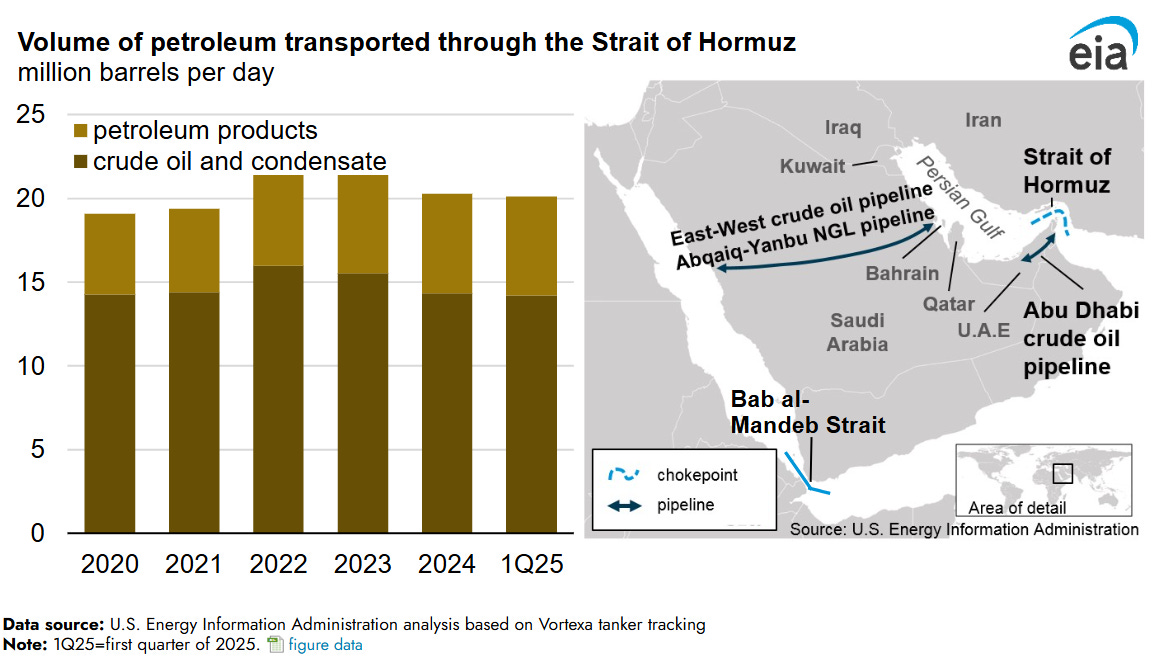
According to figures from the U.S Energy Information Administration (EIA), on an average day over 14 million barrels of crude oil and condensates are transported through the Strait of Hormuz, with over 8 million barrels destined for refineries in Asia.
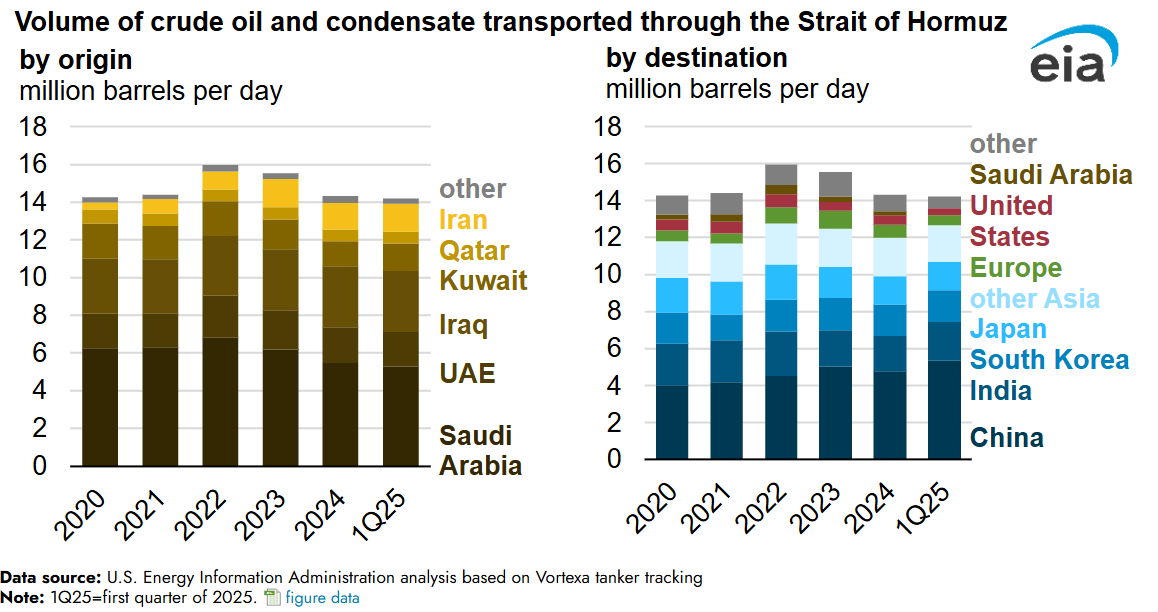
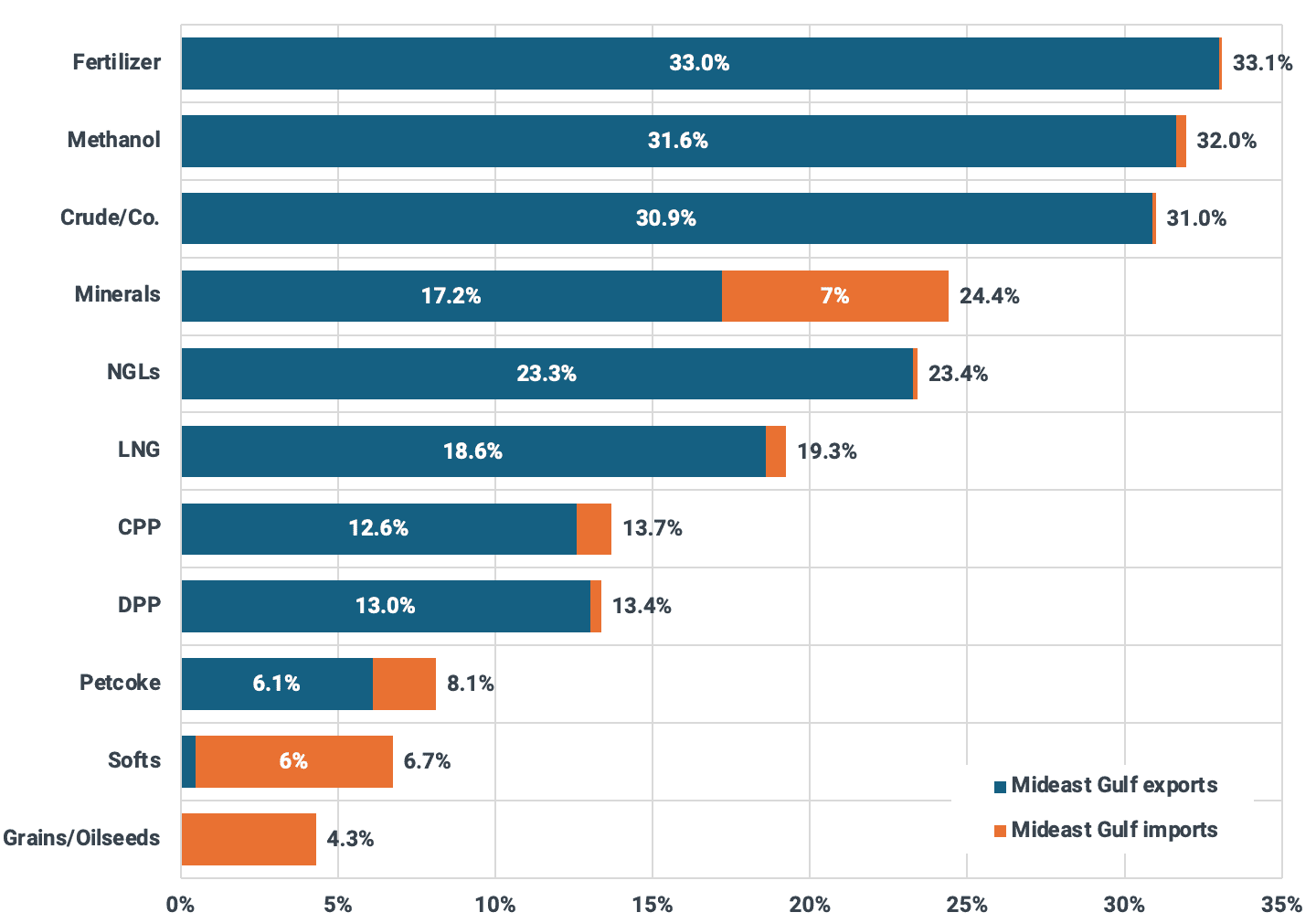
According to an analysis from global trade analysis firm Kepler, 30.9% of global crude oil exports make their way through the Strait of Hormuz.
But there are other vital commodities which flow through the Strait of Hormuz that could be at risk.
Including but not limited to 33.0% of the world’s fertilizer exports, 18.6% of the world’s liquified natural gas (LNG) and 17.2% of the world’s minerals.
As of the time of this article being written a Palau flagged oil tanker, the Skylight has reportedly been attacked by Iran as it was passing through the Strait of Hormuz, four sailors were wounded in the attack and the ship is now burning.
The entire crew has been evacuated.
The China Factor
Back in 2018, when Iran’s oil exports hit their most recent cycle peak, the list of nation’s receiving Iranian energy exports was a rather long one, encompassing nation’s in all four corners of the globe.
But in more recent times, more or less the only destination for Iranian oil exports has been China.
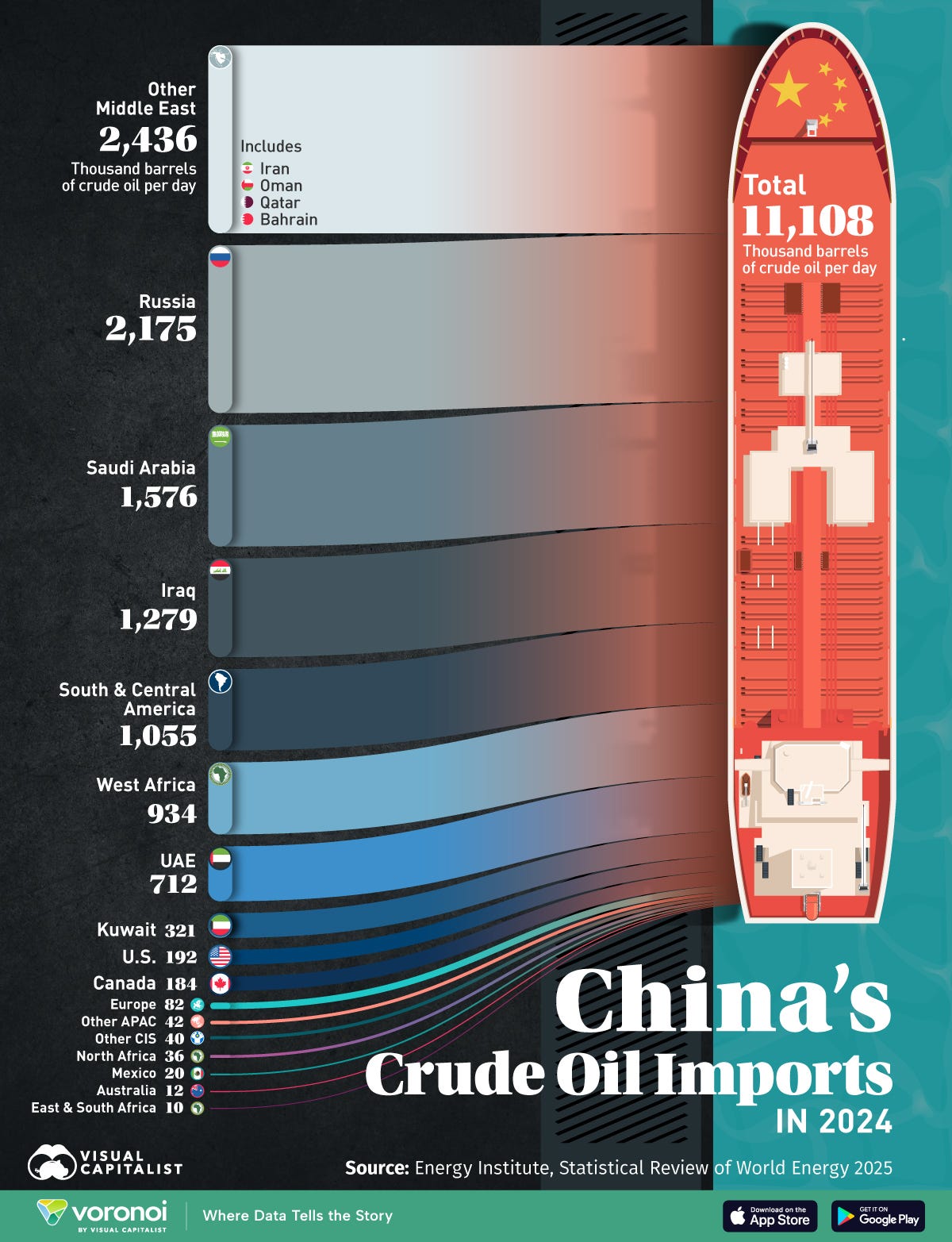
According to figures from S&P Global, in December 2025, China was the sole recipient of Iran’s 1.424 million barrels of oil and condensates per day.
Based on estimates from Columbia University’s Centre on Energy Policy, this is equivalent to 12.3% of Chinese oil imports.
Source: Visual Capitalist
This oil also comes with an added bonus, it is approximately $8 to $10 per barrel cheaper than comparable oil of a similar grade produced in Oman, according to a recent analysis from Reuters.
Combined with the potential loss of Venezuelan oil export’s, a scenario in which Iranian oil was taken off the table for Beijing would represent a major blow to China’s push to secure its energy supplies.
Depending on which estimate one uses for the flows of sanctioned oil to Beijing, having Iranian and Venezuelan oil exports to the Middle Kingdom taken out of the equation is the equivalent of 15.5% to 19% of China’s total annual oil imports.
The Geopolitics
Iran has long been a thorn in the side of the United States, from the Hostage Crisis shortly after the Islamic Revolution in 1979 to Iran armed and trained proxies attacking U.S forces in Syria as late as last year.
The toppling of the Iranian government, which is the stated goal of Washington, would be a seismic shift in the balance of global geopolitics, even beyond the aforementioned potential transformation in control over the flows of oil.
Perhaps one of the best explanation’s of the shift in American policy comes from U.S President Donald Trump’s Truth Social account, where he recently shared an article entitled:
‘The “Donroe Doctrine” In Action’ from Claremont Institution publication ‘The American Mind’
For those who may not be familiar with it, the term ‘Donroe Doctrine’ is a play on the 19th century Monroe Doctrine.
The Monroe Doctrine has its origin in 1823 and is named after it’s creator U.S President James Monroe.
In short, it was a major goal of U.S foreign policy that the European powers should not interfere in the America’s, that it would effectively be in the sphere of influence of the United States and no one else.
In the article it’s author argues that by toppling the Venezuelan government of President Nicholas Maduro and end the rule of Iranian theocracy, that it “just might have forestalled Communist China’s expected invasion of Taiwan.”
The logic is that by raising costs for Chinese consumers through higher oil prices driven by the removal of cheap sanctioned oil will deter a Chinese invasion of Taiwan.
Perhaps the most illuminating element of the article is it’s final word:
“Iran and Venezuela helped fuel the Communist China-dominated order. By helping remove hostile regimes in both countries, Trump is pulling out the linchpins without resorting to war.”
In short, the United States has significantly undermined Chinese interests and geopolitical influence without firing a direct shot at the Middle Kingdom.
A similar conclusion has long been shared by Geopolitical Strategist Velina Tchakarova.
“Those believing there’s no structure behind Trump’s actions were led by their disdain. All flashpoints are connected dots in a strategy that aims to concentrate all efforts on China & the Indo-Pacific.
Venezuela, Panama, Cuba, Arctic, and Iran are part of the DragonBear network.” Tchakarova recently wrote on X (formerly known as Twitter)
The Takeaway
Back in January, I wrote in the conclusion of my article on the American attack on Venezuela that:
“Claims of a “Rule based international order” were always a soundbite that didn’t live up to it’s promises when confronted with more challenging geopolitical scenarios, but this has effectively removed the velvet glove from the iron fist.”
Today, that is even more self evident than ever, as the air power of the United States Armed Forces streaks through the skies of Iran with near impunity.
The gloves are off and President Trump is telegraphing the intentions of the United States.
China expert, author and former Associate Professor Christopher Balding characterised it as as sending as message like a mob boss.
“China and the CCP don't operate under a system most normal people can relate to. You want to send a message? You put a horse head in the bed, put one between the eyes, make them an offer they can't refuse. Have I made myself clear?”
“So when Trump lands in Beijing he will be able to scroll through pictures on his phone of the Ayatollah, Maduro, and others in his group chat with Xi. Trump doesn’t even need to say anything the message is very clear.” Balding wrote.
Going forward, there are on one hand claims that this brings the world one step closer to a clash of the superpowers, that by moving to reduce China’s sphere of influence and threaten the supply of vital energy imports, that Trump has ratcheted up the chance of conflict.
On the other, there is the argument that by showing overwhelming strength and the willingness to use it, Trump has reduced the chance of a clash over Taiwan and by extension kept the peace by the sword.
Ultimately, the geopolitical landscape is undergoing the most profound shift in the tectonic plates underpinning it in decades and the road ahead is more filled with uncertainty than at any point in recent memory.
— If you would like to help support my work by making a one off donation that would be much appreciated, you can do so via Paypal here or via Buy me a coffee.

If you would like to support my work on an ongoing basis, you can do so by subscribing to my Substack or via Paypal here
Thank you for your readership.
Hi Tarric, A good analysis but my feeling is that the world is more secure and certain with a strong US leader willing to take action. I think China will not provoke the USA at the moment because they can be CERTAIN that the USA will react.
The so-called "Rules based order" was a smoke screen and now the narrative is much more open and people and countries need to take sides which then feeds into what they believe in and the values they hold.
I LOVED the comment by Eugyppius "geopolitical nonentity Ursula von der Leyen announces her determination to begin intensively monitoring the Iran situation as soon as the weekend is over". Cheers Peter, Brisbane