
Australian Household Spending Tanks While Inflation Runs Hot
Real per capita falling across the board

Amidst a challenging backdrop of uncertainty related to the crisis in the Persian Gulf, still simmering domestic inflationary pressures and highly depressed consumer confidence, concerns over the future path of the Australian economy continue to build.
In May, RBA Assistant Governor Sarah Hunter gave a speech to the Bloomberg Forum for Investment Managers, during which she shared the RBA’s view that a much more serious economic downturn and deterioration of the labour market could be required to tame inflationary pressures.
“Moreover, if (inflation) expectations rise persistently, it becomes harder for the central bank to bring inflation back to target, as it must both bring expectations back down and restore the balance between supply and demand”.
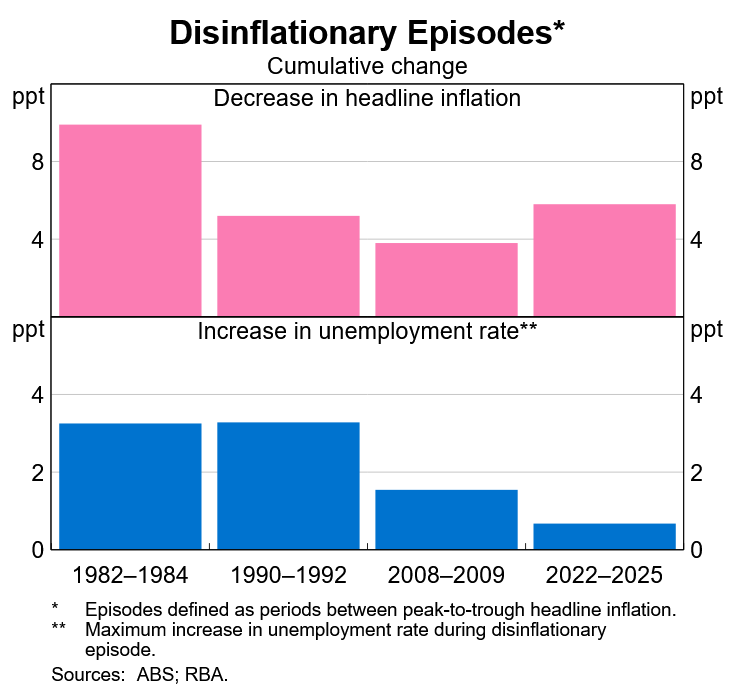
“Doing so may require a more substantial slowing of economic activity, as we saw during the early 1990s recession (Graph 6 below). So it’s crucial for central banks to keep inflation expectations anchored around the inflation target.” Hunter said.
Looking at the latest per capita Household Spending Indicator data from the Commonwealth Bank, the consumer economy is beginning to slow dramatically.
In the face of recent rate rises, as well as high levels of uncertainty stemming from the crisis in the Middle East and the potential impact of the recent federal budget, this is hardly surprising.
But as the chart below which is adjusted into inflation adjusted per capita terms reveals, the deterioration in the spending of the nation’s households had begun before a shot was fired in the Persian Gulf.
In February, real per capita spending year on year contracted by 2.9% for outright home owners and by 2.1% for renters, with mortgage holders seeing their spending rise by 0.3%.
Brief side note: The temporary surge in spending in March was largely due to the dramatic increase in the cost of petrol and diesel stemming from the war in the Middle East.
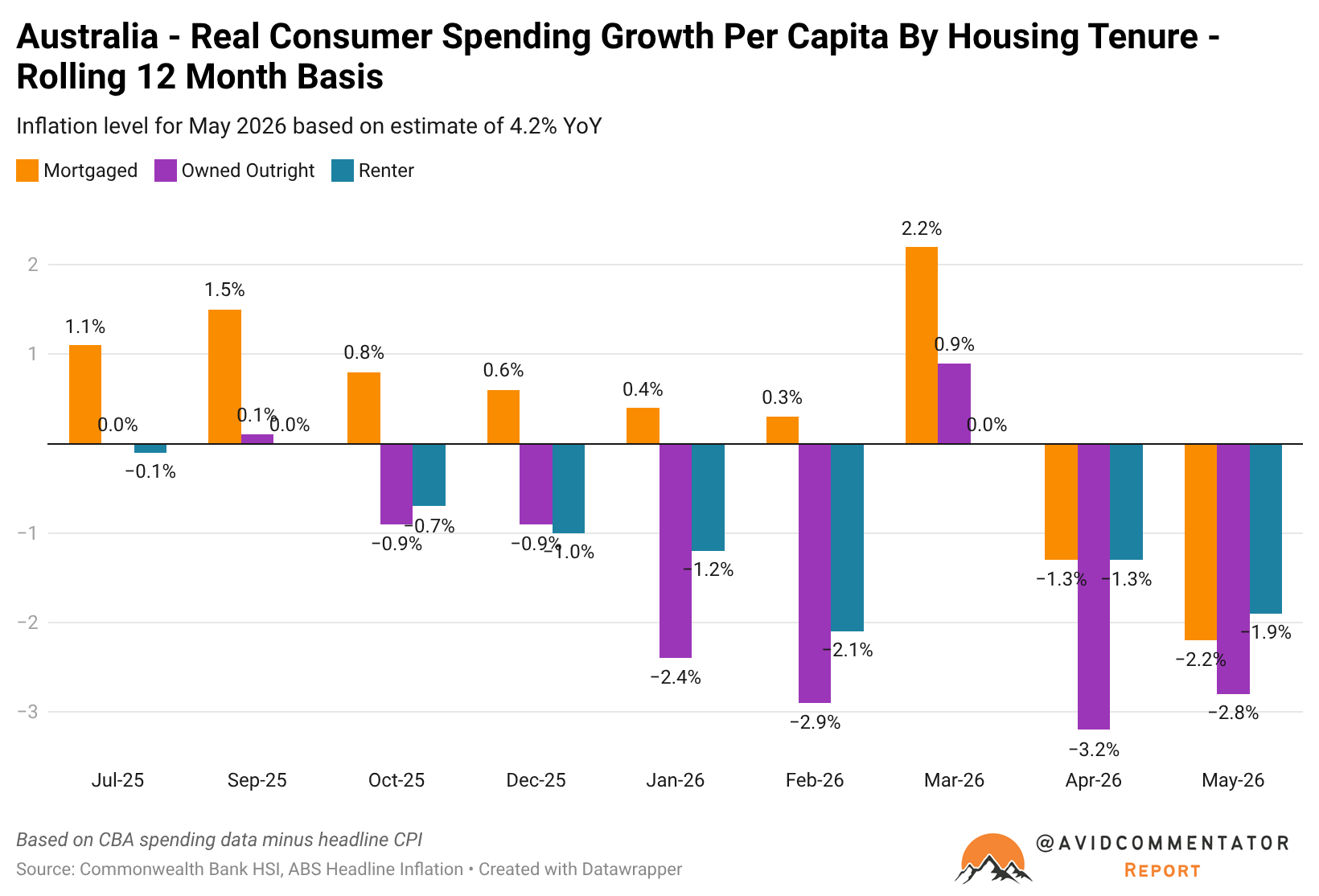
[Please note the inflation figure for May 2026 used an estimate of 4.2% year on year, this is at the lower end of analyst forecasts currently available at the time of the writing of this article]
Since the war driven bump in consumption, per capita real spending has further deteriorated, with mortgage holders now seeing their spending declining.
Part of what makes the current combination of circumstances so concerning is that this deterioration in the fortunes of households does not necessarily mean that inflation will be tamed by the fall in per capita household consumption.
Between March 2022 and March 2025, per capita spending (ex-housing) fell in aggregate, with the falls entirely concentrated in the under 55 age demographic.
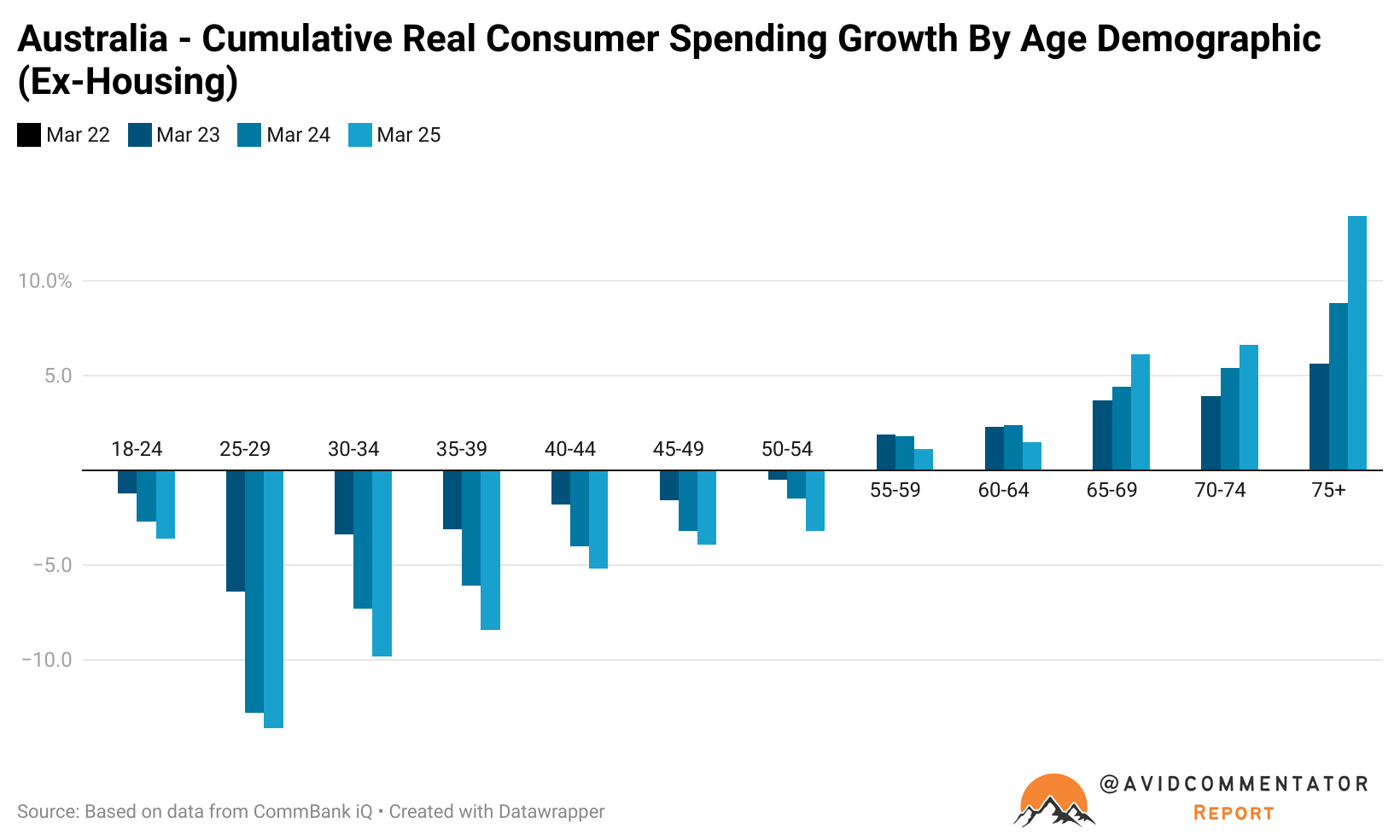
But despite households seeing the most significant and sustained hit to their non-housing consumption spending since at least the 1990s recession, this did not tame underlying inflationary pressures.
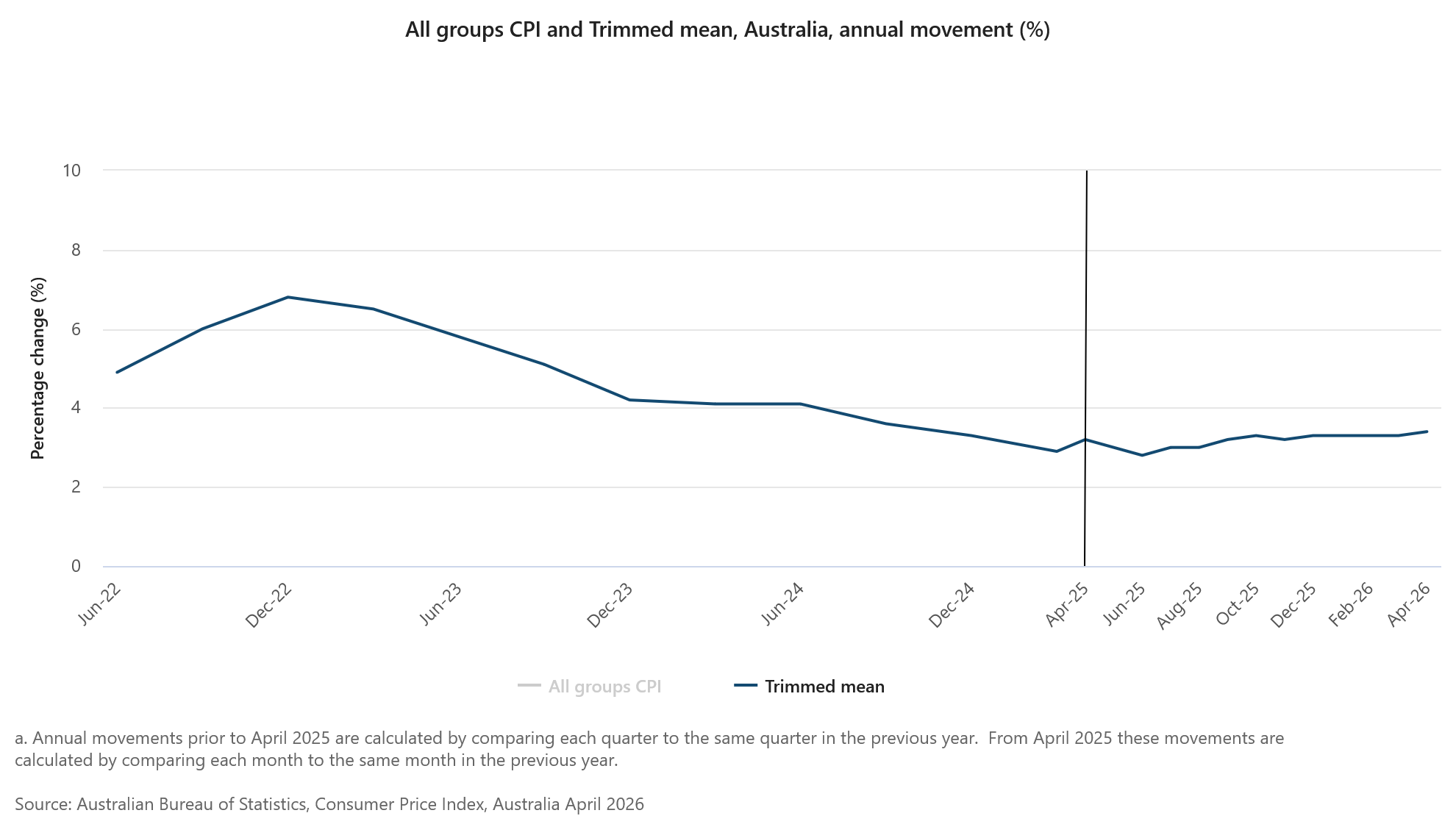
Since underlying inflation first exceeded the RBA’s 2-3% target band in the March quarter of 2022, the RBA’s preferred inflation metric, the trimmed mean, has had just two inflation reports under 3%.
The Takeaway
The data reveals a similar picture to the one that has emerged over much of the last four years, per capita spending growth at a granular level is weak and inflation remains deeply problematic.
Despite the sacrifices households are making to their consumption, both through inflation eating away at their purchasing power and through higher rates, a combination of still historically high migration, near zero productivity growth and strong levels of government spending growth are playing major roles in ensuring that inflation remains a continuing issue.
From a political perspective this is fertile ground for a continuing expansion of the growing discontent seen in various polls, which is driving the fragmentation of the landscape of federal politics.
Ultimately, the current set of challenging circumstances are heavily driven by decades of failed policy settings from both sides of Australian federal politics, pursuing settings that hollowed out the economy and relied upon a strategy that temporarily boosts headline growth at the expense of growth in long term living standards.
— If you would like to help support my work by making a one off donation that would be much appreciated, you can do so via Paypal here or via Buy me a coffee.

If you would like to support my work on an ongoing basis, you can do so by subscribing to my Substack or via Paypal here
Thank you for your readership.
So, what's the answer? We have created a lot of fairy floss type wealth in the housing sector for the over 55s and made it very difficult to house younger people who have less to spend. Inflation is partly home grown due to costs of building in part due to insistence on 'standards' and a more rigorous permitting regime, and the 'green transition' driving up the cost of powering everything, we have actively stopped the drilling for oil and gas and failed to take advantage of the gas from the North West shelf or our uranium endowment. Add to that the inflationary impact of increased interest rates and the burgeoning cost of social services that are an inevitable consequence of failing to house people properly. Seems to me that political parties across the board are unable to prioritise and government is too centralized. People could adapt and innovate to lead the way if there was more ability to innovate locally, especially outside the bounds of our dysfunctional urban sprawl where people spend to much of their time behind the steering wheel of a powered conveyance. Now consider this: it costs $2700 to get a forty foot container out of a port and $2700 to have the contents delivered to a destination 250km away as against $5800 to get it from Qingdao to Fremantle.
Labor has successfully destroyed this (once great) Australia we all grew up in via their idiotic Marxist ideology & incompetence 🇦🇺🤡